In geometry, there is a basic set of simple facts or truths that are called postulates. (They are also known as axioms). This set of postulates or basic truths are independent of each other. They cannot be proven. They are just accepted as true. For example, two points determine a line. There is no logical way to prove it. It is just a simple, basic truth.
The power of geometry comes from this set of postulates. (I should also include its set of definitions too.) Any geometric situation or theorem that you may run into, can be logically deduced, or linked to, or proven from the set of postulates.†
As it turns out, Jesus gave us a set of postulates or basic truths to live by in His two commandments, love God first, and love your neighbor.
“Teacher, which is the greatest commandment in the Law?” Jesus replied: “‘Love the Lord your God with all your heart and with all your soul and with all your mind.’ This is the first and greatest commandment. And the second is like it: ‘Love your neighbor as yourself.’ All the Law and the Prophets hang on these two commandments.” Matthew 22:36-40
If Jesus’ two commandments are like postulates, then the Ten Commandments are like theorems. Each and every one the them can be linked to either love God, or love your neighbor. In fact, everything in the Bible is based on these two commandments. (Like a math textbook, I leave it to the reader as an exercise to match up which of the Ten Commandments link to which one of the commandments by Jesus.)
But, Jesus’ two commandments are different than those of the postulates from geometry. The geometric postulates are independent from each other and stand on their own merit. Jesus’ two commandments depend on each other. The one cannot exist without the other. One cannot separate love of neighbor from love for God. Every time you serve someone, or make a real positive human connection, you show your love of neighbor; and thus you show your love for God. Love for God and love for neighbor build upon and into each other like a möbius strip.‡
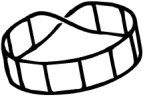
a möbius strip
There is also one more important difference. The geometric postulates cannot prove everything.† Jesus’ two commandments work for everybody and every situation.
Want to know God’s will? Love Him and love your fellow humans. With everything that entails, it will guide you in the right decision every time.
† There is something called the Incompleteness Theorem that limits our ability to prove everything within any given axiomatic-based logical system.
‡ A möbius strip is a piece of paper with the ends glued together with a twist in it. This object has the curious property of having only one edge and one side, even though it appears to have two edges and two sides. If in doubt, begin tracing one of the edges in the picture. You will be able to traverse both the top and bottom edges without lifting your finger.