In today’s Gospel reading of Matthew 5:1-12, Jesus begins His Sermon on the Mount with the Beatitudes:
-
Blessed are the poor in spirit, for theirs is the Kingdom of heaven.
-
Blessed are they who mourn, for they will be comforted.
-
Blessed are the meek, for they will inherit the land.
-
Blessed are they who hunger and thirst for righteousness, for they will be satisfied.
-
Blessed are the merciful, for they will be shown mercy.
-
Blessed are the pure of heart, for they will see God.
-
Blessed are the peacemakers, for they will be called children of God.
-
Blessed are they who are persecuted for the sake of righteousness, for theirs is the Kingdom of heaven.
Here is a shorter version of the Beatitudes that has helped me step into contemplation about them:
-
Happy are those who need God.
-
Happy are those with self-control.
-
Happy are those who are sorry for sin.
-
Happy are those who hunger and thirst for holiness.
-
Happy are the merciful.
-
Happy are those who love with all of their heart.
-
Happy are the peacemakers.
-
Happy are those who suffer for doing what is right.
Someone once wrote that the Beatitudes are to Jesus as the Ten Commandments are to Moses. (Why didn’t we see the Beatitudes posted next to the Ten Commandments in court houses and schools before they had to take them down?) This is a good analogy because each seems to sum up the ministry of both men. The Ten Commandments are a key stone for understanding the Old Testament. The Beatitudes are a key stone for understanding the New Testament. Except, there is a big difference in their application and motivation.
The Ten Commandments are a minimum—a minimum set of rules to follow. Follow the Law and you shall enter the Kingdom. The Beatitudes are a maximum, something for which to strive. There is always room for improvement with the Beatitudes. The Beatitudes are all about attitude, be these attitudes, be like Jesus. God is more interest in your being than your doing (although doing affects your being). The Ten Commandments are about watching what you do, external control. The Beatitudes are about who you are, your being, internal control. True, lasting change comes from with in, not from with out.
The Ten Commandments are a starting point, which can lead a person to do the right thing for the wrong reason. The Beatitudes are a goal, a direction to walk, which leads a person to do the right thing for the right reason.
Both the Ten Commandments and the Beatitudes are important. The Ten Commandments are a starting point for the journey home to heaven; the Beatitudes help keep us on the right path.
Isn’t it funny how simple it is for people to trash God and then wonder why the world’s going to hell?
Isn’t it funny how we believe what the newspapers or TV news say, but question what the Bible says?
Isn’t it funny how everyone wants to go to heaven provided they do not have to believe, think, say, or do anything the Bible says?
Isn’t it funny how someone can say “I believe in God” but still follow their own way? (FYI: Satan, by the way, also “believes” in God.)
Isn’t it funny how you can send a thousand jokes through e-mail and they spread like wildfire, but when you start sending messages regarding the Lord, people think twice about sharing?
Isn’t it funny how the lewd, crude, vulgar and obscene pass freely through cyberspace, but the public discussion of Jesus is suppressed in the school and workplace?
Isn’t it funny how someone can be so fired up for Christ on Sunday, but be an invisible Christian the rest of the week?
Isn’t it funny how I can be more worried about what other people think of me than what God thinks of me?
Are you laughing?
I have seen what I know,
I feel much more than I know I know.
I have shown what I have,
I have given much less than I have had.
I have stood up for those things I chrish,
I have retreated, or compromised in heart,
Much more than I have stood for.
So when I fail—to know, to give, or to protect—
Forgive me.
If it be your will, God,
Preserve me through the day.
Let my encounters be blessed,
Let my meals be blessed,
Let my coming and my goings be blessed,
And help me see your hand in all things.
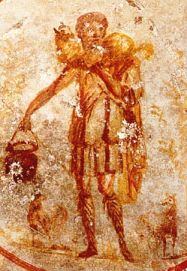
The Good Shepherd
Catacombs of Rome, 284 AD
The Savior, thus the good pastor,
which means the good shepherd,
Carries this sheep on piggyback,
the sheep that was lost,
that was going to get lost
So that the stones in the path
wouldn’t bruise its bruise feet.
Because there will be more joy in heaven
over one sinner who returns,
Than for a hundred righteous ones
who never left.
Because the hundred righteous ones
who haven’t left will have remained.
They will have remained only
in faith and in love.
But the sinner who left
and who almost became lost
By his very going away,
and because he was going
to miss the evening call
He aroused fear and
thus he caused hope itself
to spring forth
from the very heart of God,
From Jesus’ heart
The shudder of fear and the shiver,
The tremor of hope.
Because of this lost sheep
Jesus experienced fear
in love itself.
And the kind of tremor
that divine hope creates
in love itself.
And God had been afraid
he’d have had to condemn it.
By this sheep, and because
it wouldn’t return to the fold,
and because it was going
to miss the evening call,
Jesus, as a man,
came to know human anxiety,
Jesus made man,
He came to know what anxiety is
in the very heart of love,
The gnawing anxiety
in the worm-eaten heart of love,
But thus he also came to know
the very first hint
of hope’s awaking.
When the young virtue hope begins
to rise in the heart of man,
Under the rough bark,
Like the first bud of April.