Time, Prayer, and the Body of Christ – Part 2

Faith is daring of the soul to go farther than it can see.

— William Newton Clarke

See Part 1.

To no fault of our own, humans are largely stuck with the idea that time is a linear sequence of events. Things happen one after the other. Yesterday was, today is, and tomorrow will be. We are constantly thinking in terms of the past, present, and future. Just look at all the verb tenses we use within our languages.

There is a serious implication for viewing time as a chronology. Everything appears to become sets of cause and effect. If this chain of cause and effect is linked backwards, all the way back, it terminates (or begins) at a single point of creation at the start of time. Because of this chain of events, some people would say that we live in a deterministic universe. Modern scientists have invented (discovered?) the Heisenberg Uncertainty Principle to explain the randomness that appears to happen within the universe.

C.S. Lewis, in The Screwtape Letters, comments from the perspective of devils on man’s peculiar view of time as linear. He implies a larger, more encompassing reality:

…you must remember that [man] takes Time for an ultimate reality. He supposes that [God], like himself, sees some things as present, remembers the others as past, and anticipates others as future; or even if he believes that [God] does not see things that way, yet, in his heart of hearts, he regards this as a peculiarity of [God’s] mode of perception—he doesn’t really think (though he would say he did) that things as [God] sees them are things as they are! If you tried to explain to him that men’s prayers today are one of the innumerable coordinates with which [God] harmonises the weather of tomorrow, he would reply that [God] always knew men were going to make those prayers and, if so, they did not pray freely but were predestined to do so. And he would add that the weather on a given day can be traced back through its causes to the original creation of matter itself—so that the whole thing, both on the human and on the material side, is given “from the word go.” What he ought to say, of course, is obvious to us [spirits]: that the problem of adopting the particular weather to the particular prayers is merely the appearance, at two points in his temporal mode of perception, of the total problem of adapting the whole spiritual universe to the whole corporal universe; that creation in its entirety operates at every point of space and time, or rather that their kind of consciousness forces them to encounter the whole, self-consistent creative act as a series of successive events.

From our point of view within Time, an answered prayer appears to be two points in time, a sequence of events, a cause and effect. For example, when a person makes a supplication in prayer, either for him or her self, or through intercession for another, the person remembers that prayer as a point in time. As time passes, the person may notice the prayer is answered at some different point in time.
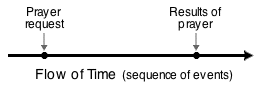
[Two Points in Time]

Accordingly, from Eternity (that is, from outside the flow of Time), God sees and acts, in a sense, perpendicularly at every point of time. There is just not one single point of creation occurring at the beginning of Time. Every point of time is a moment of creation. Creation is happening everywhere, every when. To us, it appears to be a linear sequence of “successive events.” (This is why nearly all of the saints and mystics stress the importance of living in the present moment. The present moment is where, or should I say when, God is present with us.)
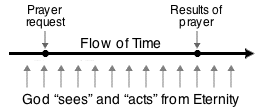
[Two Points in Time with God]

It should be noted that although God is outside of Time, Time is not separate from Him. Time flows from God, within God, much like how a song flows from a singer.

Another point should also be noted. Because we tend to view events in a sequence of cause and effect, we might be tempted to say that we can cause an effect in God through prayer. I am not prepared to make such a claim. It makes God sound like a magician, which He is most definitely not. But I do know this: if a prayer is in accord with God’s will, then it will be answered. It will be harmonized within His song of creation for His good and glory. (His good is ultimately our good too.)

The purpose of the Flatland story in Part 1 is to illustrate the dimensionality of time. We, stuck within Time, are not unlike Square stuck in his two-dimensional world. We cannot visualize being outside of Time like Square could not visualize being “above” the plane of Flatland.

Furthermore, Square could only infer his shape from his environment in Flatland. He could not see his whole, true shape until he was lifted above his plane of existence in Flatland. And then again, he did not “see” himself. He saw his true self as reflected in the descriptions from Sphere and in seeing the true forms of other squares. We, stuck in our dimension, mistake Time and Space as the ultimate reality. Since we cannot “see” above our plane of existence, we think we see all there is to what we are. The truth of the matter is that we only see part of who and what we are. We cannot see our whole, true self. We a blind and do not even know it. Only God, from His view point outside of Time, can see our true form. It is only when we loose ourselves completely to Him can we really find our true selves.

Perhaps this exploration of time and prayer can help us illuminate a small portion of the mystery of the Eucharist. We view the Sacrifice of the Cross as occurring at one particular point in time, nearly two-thousand years ago. Scripture says that Jesus’ sacrifice was the One Sacrifice for all of time. No more will ever be needed. Some people accuse the Church of denying this one particular sacrifice by repeating it at every consecration of the Eucharist. These people are stuck within a one-dimensional, linear concept of time. They cannot “see” that time can be and is transcended. The One Sacrifice lifts “above” time and connects to the present moment through the Eucharist. The Eucharist is not a re-enactment of the One Sacrifice at the Cross. The Eucharist is the One Sacrifice at the Cross, connecting us through time, through the love and power of Jesus, to His moment of victory over death.

Maybe an analogy is in order to help see how the one true Sacrifice is present to us at any time in every Eucharist. Imagine Square sitting in his house within the two-dimensional plane of Flatland. Sphere comes along and lifts Square “above” Flatland. Square is no longer visible within Flatland, but he is still present. In fact, being above Flatland, he can see all of it, and in a way, he is present to all of Flatland. Square can also, if he chooses, re-enter Flatland at any point he wants. He does not even have to travel through Flatland because he is “above” it all. It will appear instantaneous to those living within Flatland when Square does re-appear. (Imagine picking up a coin up from the table. That coin can now be placed back down anywhere on the top of that table.)

If we extend this analogy to us since we naturally view Time as a line, we see Jesus crucified at one particular point in our time line. At that point, He was lifted “above”. He is still present to all of our time line because He is “above” it. He can see all of time. He can then re-enter the time line any where (any when?) He chooses. He instituted the Eucharist to do this, to provide nourishment, to provide a means for change from within, to provide a direct physical touch from Him to us, for our journey home along this time line.

Maybe this analogy also helps explain why many people say that the most precious Blood of Christ literally washes away our sin.

Next time (sorry, pun not intended), we will connect further time, prayer, and the Body of Christ. Until Part 3…
The New Oklahoma Quarter

The new Texas quarter has been out in circulation for a while now. Oklahomans, not to be outdone, have minted their own quarter. (The U.S. Mint is not too happy about it either.) The idea was a pretty good one except for one problem—the new quarter kept jamming soft drink machines. (We call them “pop machines” here in Oklahoma.) Apparently such coin-operated devices do not like the glue used to hold the two dimes and nickle together.

Turning Toward God

I stumbled upon this weblog called Scattered Words (via mute Troubadour). The author is named Ben, and he is a 22-year old struggling with his sexual identity and his relationship with God (a double load to carry). Someone wrote him an email asking several questions about his struggle to turn toward God. His answer to the second question should hit home for all of us:

What’s the hardest part so far?

The hardest part has really been turning to God instead of turning to myself. Realizing that I can’t do this on my own…

Ahh, the first step to poverty…

An Analogy

Redemption, Reconciliation, Liberation
:::
Love, Peace, Energy
:::
Father, Son, Holy Spirit

Do not de-construct the analogy. Do not divide and separate it. Accept it in its wholeness, its connectedness. Dwell on the parts, but keep in mind how and why they are connected. It’s a gestalt kind of thing—the whole is greater than the sum of its parts. It’s a mystery to live.

Time, Prayer, and the Body of Christ – Part 1

Time and Space are not the ultimate reality.

Let’s set the stage with a simple story. In a marvelous little book by Edwin Abbott called Flatland, the main character is a geometric figure called A. Square. He is a mathematician and inhabits a place called Flatland, a two-dimensional plane or flat surface not unlike the top of a table. All of the creatures of Flatland are geometric shapes and live within this plane. Because they are two-dimensional, they do not have the concept of above or below. To them, above means north and below means south.

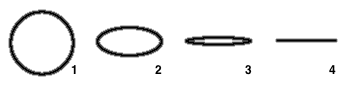
Imagine for a moment what things might look like if you lived in two-dimensions. If I asked you what shape a coin is, you probably would say and imagine a circle. But you are referencing the circle from three-dimensions. You can look from above the coin/circle. A Flatlander does not see from “above.” They see things from the side. So, now imagine a coin sitting on top of a table. As you lower your eye to the table top, the circle of the coin’s shape appears to look flatter and flatter. Eventually, when your eye is in the plane of the coin, the circle will no longer look like a circle but a line. All sense of “depth” and perspective disappear. Your vision becomes limited. All shapes in Flatland look like a line. You are then forced to infer the shapes of objects by other means, usually by touch. Now you can begin to “see” like a Flatlander.

[Looking at a circle from the edge]

The first part of the novel describes what life is like as a two-dimensional figure, and how Square’s rigid, class-structured society functions and operates. In the second part, Square is visited by a Sphere from three-dimensional Spaceland. (This novel works on many different levels. It is a cute story. It is a scathing satire on Victorian English society. It explores the mathematical relationships between dimensions. And all of it is wrapped in subtle religious undertones.)

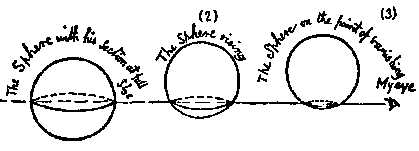
When Sphere first visits Flatland, Square just hears a voice. It seems to come from within his head (as far as it goes that a square has a head), but not really. We as inhabitants of Spaceland know that Sphere is talking to him from above. Remember, Square has no concept of above. Then Sphere moves over and begins to break the surface of the plane. From Square’s point of view, the Sphere begins as a point, then as a circle that grows in size, then a circle that shrinks in size, then to a point again, and finally disappears.

flatland-circle.gif

When Sphere re-enters the plane of Flatland at a different place, Square is astonished to see how Sphere could move from one place to another without moving within the “space” of Flatland. Then Square misidentifies Sphere as a Circle, a member of the highest, priestly class of Flatland. Actually, Flatland circles are not true circles. They are many-sided polygons on the order of 200 to 300 sides. (Each succeeding generation has a side added. Square’s sons are pentagons, and his grandsons are hexagons. Therefore, the so-called circles were the blue bloods of Flatland society with their family lines going back many generations.) Sphere appeared as a “perfect” circle with not the hint of an angle or straight edge. Square was honored to be visited by such a creature. (Note: To Square, Sphere appeared as a circle. But in reality, the Sphere was so much more than just a circle.)

Sphere’s mission was to illuminate to an inhabitant of Flatland (an event that occurs every one thousand years) to the higher natures of Spaceland. In vain, the Sphere tried to describe three-dimensions using terms like up and down, above and below, width and length and depth. Poor Square tried his best but could not understand without “seeing” it. Finally, Sphere grabbed Square’s corner and pulled him out and above the plane of Flatland. Square was amazed to see all of Flatland below him. He could see inside his house. He could see into his neighbor’s house. He even could see inside all of the polygons. He could now see what a square truly looks like, inside and out.

The rest of the story is about visiting Spaceland. They visit one-dimensional Lineland and zero-dimensional Pointland too. Square eventually irritates Sphere when he asks to visit four-dimensional land so that he could see the “insides” of Sphere. (This kind of grossed out Sphere.) In the end, when Square returns to Flatland, he is frustrated and persecuted for telling tales of a mysterious three-dimensional place called Spaceland.

I hope this little synopsis of the story of Flatland lays enough of the ground work to ponder a few points:

  • Square had to infer his shape as a square. He had never seen the shape of a square, or a pentagon, or any shape for that matter. He did not know his true identity, his true essence until Sphere lifted him above his plane of existence and he could see the reality of Flatland. In fact, Square never directly sees his own true self. It is reflected back to him in Sphere’s descriptions and in seeing other squares from above.

  • When Square asked to move to a higher dimension so that he could see the “insides” of Sphere, to see Sphere’s true shape, Sphere reacted negatively by denying the existence of such a higher dimension. (Not unlike the reaction Square receives when he returns to Flatland.) Later, Sphere admits to Square in a dream that there is such a fourth dimension and that every one thousand years, an inhabitant in Spaceland is visited by a fourth-dimensional creature.

  • It is easy for Sphere to affect a dream or a voice inside of Square since he can move in a higher dimension but still manipulate objects within the plane of Flatland, even manipulate the inside of Square’s body and mind. Sphere could not do this without Square being aware of it while Square was in Spaceland.

  • Keep in mind that from above the plane of Flatland, all of Flatland—its inhabitants, their houses, their cities and country side, everything—can be seen. Nothing is hidden. This includes seeing the true form of the Flatland creatures from the outside, but also their “insides” too.

  • Dimensions are not separate worlds or universes. They are not separate dualities or mutually exclusive domains. They do not partially overlap each other either. Each dimension is contained wholely within the larger one. What is true in one-dimension holds true for two-dimensions, but more so. Likewise with two-dimensions to three, and three-dimensions to higher dimensions.

Now, I hope upon reflection, the religious implications of this story may begin to become evident. How can we extrapolate this story to us, to God, to time, prayer and the Body of Christ?

Until Part 2…